
Workforce Innovation Fund
Housing and Employment Navigator Model

The Model
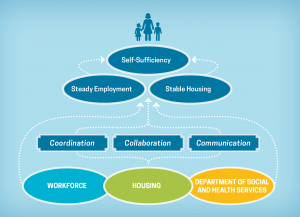
Workforce Innovation Grants encourage service delivery changes that result in better outcomes and lower costs. The model’s intervention relies on the role of the navigator – in this case a local workforce staff member. The navigator provides direct support to help families get training, find and keep jobs, move into permanent housing and make progress toward self-sufficiency.
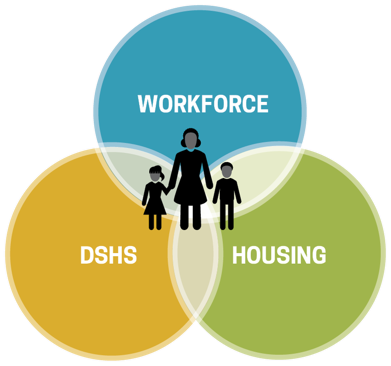
Navigator intervention creates a single point of contact for clients who are often addressing formidable issues. The navigator connects the client to other service providers and helps develop a coordinated response to client needs. This team approach includes regular meetings between service providers, especially housing case managers and DSHS contacts.
Navigators also can draw on a financial attainment fund that provided quick access to flexible dollars to address client emergencies where other funds weren’t available.

One-on-one
A Navigator works one-on-one with families to assess their individual circumstances and address specific barriers to employment within the household.
In the recently completed Navigator Model study, four counties followed these same general steps in working with clients and service partners.

Referred by Housing Provider
The family is referred to workforce navigator by local housing provider.

One-on-One Assistance
A navigator works one-on-one with head of family.

Cross-System Team
The navigator convenes a team to assist family with employment, housing and social services.
Coordination, Collaboration, & Communication
Team members communicate regularly to ensure coordination of services.
Barrier Resolution
Team works with family to address and resolve barriers to employment.
Connect to Community
The team connects the family to community services not offered by core partners if needed.
The Study
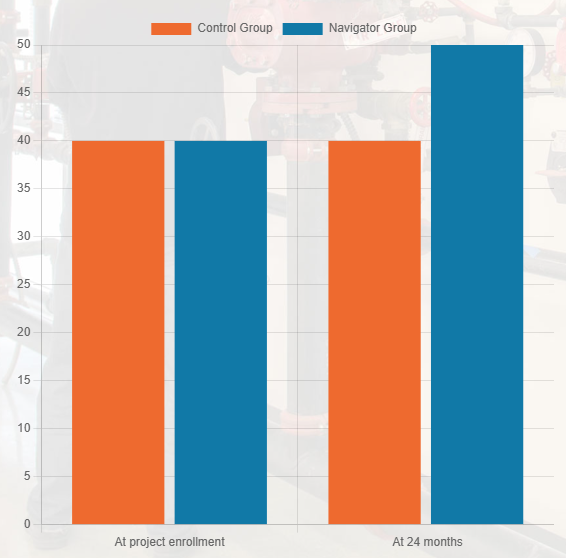
When compared to control group clients…
Short-Term
- Do Navigator clients demonstrate larger increases in self-efficacy?
- Do Navigator clients demonstrate larger reductions in family barriers to success?
- Do Navigator clients demonstrate larger increases in understanding of available support services?
- Do Navigator clients demonstrate larger increases in participation in education and training programs?
Long-Term
- Do Navigator clients demonstrate higher rates of employment?
- Do Navigator clients demonstrate higher rates of employment retention?
- Do Navigator clients demonstrate higher average maximum hourly wages?
- Do Navigator clients demonstrate higher rates of permanent housing?
- Do Navigator clients receive lower amounts of several forms of public assistance?
Key Findings

This model shines light on a new way for workforce development partners and human services organizations to do business.
- Increase collaboration between and among agencies and organizations.
- Measure the results of your collaboration.
- Share these findings with partner organizations to fundamentally change how workforce development and housing services are offered.
Employment rates for navigator clients jumped between the 18- and 24-month follow-up periods. At 24 months, the study found navigator clients had a 10 percent higher employment rate than people in the control group. Client and stakeholder interviews, as well as activity data, showed that navigators worked with 93 percent of their clients on employment services; 80 percent of clients participated in education or job training.
The study found that, at 24 months, navigator clients showed an 11 percent higher employment retention rate over control group participants. Employment retention was measured as having retained employment for at least 6 months.
At the 24-month follow-up period, the housing permanency rate for navigator clients was 5 percent higher than that of the control group. This data point suggests the possibility of long-term benefits to the navigator model.
Clients who worked more closely with their navigator on housing showed substantially higher long-term housing rates that those who had less interaction with navigators, suggesting navigators experienced an increased willingness to use attainment funds to support housing needs the more they interacted with their client.
The study looked at the utilization of public assistance through TANF, food stamps and DSHS medical insurance.
TANF utilization initially went up within the navigator group as clients were helped to access needed resources. By 18 and 24 months, however, TANF utilization was decreasing. This was the same period in which employment rates for the navigator group increased significantly.
Food stamp and medical insurance assistance showed little variation between groups at 18 and 24 months. This aligns with the study’s finding of insignificant variation in hourly wages. Because employment and retention rates started to show significant differentiation at 24 months, it is possible that a longer study would show more distinction between the groups.
The Partners
Regional Workforce Councils
- Workforce Central (Pierce County)
- South Central Workforce Council (Yakima County)
- Northwest Workforce Council (Whatcom, Skagit and Island Counties)
23 different local housing providers DSHS, Community Services Offices
U.S. Department of Labor/Workforce Innovation Fund
- 5-year research study grant
Building Changes
- Training and technical assistance
Marc Bolan Consulting
- Evaluation



© 2017 Workforce Central, WA. All Rights Reserved. Infographics courtesy of Y Art Works. Created by JayRay